SunSpaces website


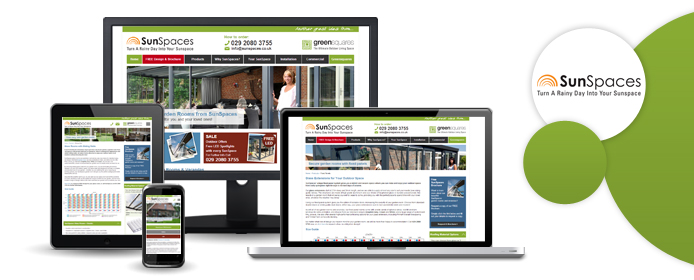
If you'd like to add a little something extra to your garden, our latest project may well be of interest to you. We recently completed a brand new website for SunSpaces, an up-and-coming outdoor business specialising in stylish glass verandas and gorgeous garden rooms.

SunSpaces' unique selling point is their ability to provide something completely bespoke. There are several UK companies who provide sunrooms similar to those sold by the SunSpaces team, but not only do SunSpaces use better materials than most of their competitors, they are also far more flexible, offering a colossal range of options and aiming to provide a living space that's tailored to each individual customer.

The new SunSpaces site is completely responsive, allowing potential customers to research the company's garden rooms on the go and find out a little bit more when they get home. The website's purpose is to drive enquiries for the business; to get people on the phone so that the SunSpaces team can discuss the customer's options and explain in detail just what the company can do. To assist with this goal, we made sure that the company's contact details were clearly displayed at the top of each page, and that all of the content was carefully geared towards sparking those all-important enquiries.

To see the SunSpaces website for yourself - and to find out more about adding a garden room to your property - visit www.sunspaces.co.uk now.

Today is Safer Internet Day! This annual event is organised by the UK Safer Internet Centre as a means of promoting online safety for children and young people; the slogan for this year is 'Let's create a better internet together', and we at Designer Websites want to do our bit!

Here, then, are a few simple online security tips that will help your kids (and indeed you yourself) to stay safe and secure while you surf the web:

  • Create a strong, unique password. When helping your children to set up online accounts of any kind, encourage them to think carefully before selecting a password. Avoid obvious sequences like abc123qwerty and 1234567 and popular phrases like batmanfootball or dragon. Oh, and NEVER use your own name as a password!

  • Use different passwords for different accountsOnce you've thought of a good password, it can be tempting to use that same password for every account you set up. This is a big mistake; using the same password for everything means that, if somebody breaks into one account, they can easily gain access to all of the others. Try to think of a different password every time.

  • NEVER share or publish your login details online. You never know who might see them!

  • Parents: research adult content filtersIf you want to make sure that your children don't view any adult content while they use the internet, there are a number of plug-ins that can help you. Adult Blocker is a highly-rated plug-in for Google Chrome, and FoxFilter is the #1 parental control for FireFox. Internet Explorer, meanwhile, has built-in parental controls; just click on the cog in the top-right corner of any IE window, then select Internet Options > Content Family Safety to set parental guidelines for your children's internet use.

  • Parents: use the sites your children useOne last tip for parents (and teachers, too) - get to know the sites your children are using. For example, if they have a Facebook page or a Twitter account, set up a profile of your own and learn how to use it; this will ensure that you understand what your children are doing online, and help you to advise them when it comes to privacy settings.

Gibran site previews

Gibran is a not-for-profit organisation based in Monmouthshire. They work with female (and, more recently, male) offenders throughout Wales, helping and supporting them while they rebuild their lives.

Gibran approached Designer Websites because they wanted their website to look more modern and give visitors a better experience. They wanted a good place to talk about their projects and events, but more importantly, they needed to give vulnerable people a quick, easy way to get in touch with the Gibran team.

The new Gibran website is now live, and we feel that it fulfils every aspect of the brief we were given. The responsive design is equally easy to navigate on all screen sizes, allowing those who need Gibran's help to access and use the organisation's site via smartphone, tablet, desktop computer, and any other device - whatever is easiest for them. Information about Gibran's work is laid out clearly on all pages, and every page has an enquiry form in the footer, allowing quick contact from any point in the website.

Gibran's cause is a very worth one indeed, and we hope that this new site serves their purposes well. Click here to see the website and learn more about Gibran UK.

PrimaPorcelain site screenshots 

Back in 2013, we created a website called PorcelainPaving.co.uk. Owned by outdoor specialists Greensquares, this site was specifically designed to show off the company's stylish range of porcelain tiles and paving slabs to potential customers.

PorcelainPaving.co.uk has proven extremely successful indeed, receiving a very healthy amount of traffic and allowing Greensquares to make these paving products a much larger element of their overall business. In fact, their porcelain range now has a brand name of its own: PrimaPorcelain.

Of course, a new brand calls for a new design, and we have recently been working hard to turn the old porcelain paving website into the new PrimaPorcelain website.

This doesn't just mean that we've been changing a few bits of text - the site has been given a complete overhaul, and PrimaPorcelain.co.uk now has an elegant responsive design and an intuitive new 'Product Selector' tool that allows customers to filter PrimaPorcelain's range (which has grown exponentially since 2013!) by colour, texture, and indoor/outdoor use.

The new PrimaPorcelain website is a big step up for the brand, and we hope that it will be even more successful now than it was in its old guise. Click here to visit PrimaPorcelain.co.uk.

Is SEO Dead?

We've seen a lot of articles in the last few months with titles like this:

"Yes, SEO Really is Dead!"

"Stop Doing SEO - It Doesn't Work Anymore"

"SEO is over. Here's the new way to get your site seen!"

Invariably, these pieces will talk about the supposed demise of search engine optimisation as a worthwhile practice. They use the following arguments to convince readers that SEO is, indeed, a thing of the past:

  • Link-building doesn't work anymore. Seeking out links from external websites used to be a huge part of SEO, but inbound links are no longer an automatic guarantee of high rankings - these days, quality is far more important than quantity, and it can be very difficult to manufacture a really good link to your own site. Also, Google are getting much better at spotting unnatural and/or manipulative links and punishing the sites on the receiving end; this has put an end to linkbuilding as an effective means of boosting rankings, or so some bloggers would have you believe.

  • Keywords are more complicated than ever before. Once upon a time, you could achieve high rankings for a search term like 'cheap sofas' by simply mentioning 'cheap sofas' a hundred times in your site copy. Nowadays, the system is a lot more complex - search engines are aware of things like synonyms, closely related topics, and a whole variety of other ranking factors that don't have anything to do with keyword density. Also, Google and their competitors have learned to spot keyword-stuffed content from a mile away, and the penalties for this can be just as severe as the slap you'll get for dodgy link-building.

  • Sites should be optimised for users, not search engine bots. The problem with a lot of old SEO practices (particularly keyword stuffing) was their tendency to make things unpleasant for the user. You can write a 500 word essay that uses the phrase 'best mobile phones' in every other sentence if you so desire, but even if it ranks highly, it's not going to make especially riveting reading; in fact, all of that keyword stuffing might well make it harder for your customers to find the information they need. Nowadays, a good user experience is valued above high rankings, and since aggressive SEOing can quite easily get in the way of a strong UE, those practices no longer have a place on most websites.

Now, these are some good points - keyword stuffing and link farming do more harm than good, and we would certainly advise any webmaster to stay well away from these practices if they value their site traffic. But SEO isn't just the black hat stuff; those three letters may have picked up some negative connotations over the years, but search engine optimisation is still alive and well, and if you want your website to have any kind of presence on Google, Yahoo! and Bing, you absolutely must take it into consideration.

First of all, you need to stop viewing SEO as a shady effort to fraudulently boost a site's rankings. SEO is actually a very important part of website design, and it starts with the code itself - our developers have spent the last decade building sites in a way that's easy for Google and other search engines to digest. We also work hard to create lightning-fast pages, user-friendly functionality, and so much more; all of this is as much a part of SEO as strategic keyword placement.

But we won't bore you with an in-depth dissection of good quality code. Instead, allow us to address the points above, and demonstrate why SEO remains very much alive:

  • Links are still important. Building a lot of low-quality links to your site is unlikely to do much for your rankings nowadays, but remember what we said about quality and quantity? That's an important thing to bear in mind - Google themselves have stated that inbound links are still a major part of their algorithm, it's just that they're now more interested in the value of your links than in how many you've amassed. Of course, since artificial links can land a site in very hot water, it's better to focus your SEO efforts on creating a site that encourages people to link unsolicited - make it easy to link, and make sure you provide something that's worth linking to. This is what really impresses search engines at the moment.

  • Keywords still have their place. Modern SEO demands a rather less ham-fisted approach to keyword placement, but that doesn't mean you should forget about keywords altogether. When creating your website, think about the search terms you would like each page to show up for, and then tailor your copy and any other content to those keywords. Make sure you're providing potential users with the clear information and the useful resources that they are likely to be looking for, and this will make each page's purpose clear to search engines as well.

  • User optimisation and SEO are, in many ways, the same thing. User optimisation makes your site more appealing to humans. Search engine optimisation makes your site more appealing to search engines. These two practices are very closely related, especially as search engines get smarter and more capable of thinking like humans. The articles we've read always tell you to forget about SEO and concentrate on the user experience, but this is misleading - they are two equally important undertakings that will yield sizeable rewards if done properly in tandem.

To answer that million dollar question, then: no, SEO isn't dead, it's just different to what it was a few years ago. Mind you, this shouldn't surprise anyone (least of all the type of people who are liable to write 'SEO is Dead!' aritcles) - SEO has been an ever-changing entity since day one, but none of its transformations have ever negated its usefulness as a practice. In fact, as web designers, optimising for search engines is one of our most important jobs!