
Why Won't My Website Show Up on Google?
It's frustrating when your website can't break onto the first page of Google results for that high-volume search term you've been trying to target, but it's even more frustrating when your website isn't showing up on Google at all.
Why does this happen?
In order for a page to appear as a Google result, it has to be included in Google's index.
When Google notices a new website for the first time, its bots 'crawl' the site and report back so that the site's pages can be added to the index. However, Google doesn't index all pages indiscriminately – even our tech overlords don't have the luxury of unlimited server space.
For this reason, if a page doesn't meet certain requirements, Google won't bother to index it. Their algorithm might even decide that none of your pages add any value to the Internet, in which case your whole website may be excluded from the index. And if you're not in the index, you can't show up in the SERPs (search engine results pages).
Check to see if you're indexed
If Google isn't showing your website in the search results – even for terms that you really ought to be ranking for, like your company name – the first thing to do is find out whether or not you're even indexed.
Here's how to do that:
1) Go to google.com (or if Google is your browser's default search engine, just open a new tab).
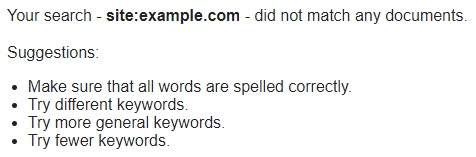
2) Type your website address into the search bar, preceded by 'site:' as shown in the example below.

3) Hit enter. Google should now show you a list of your web pages – if none of them are indexed, you'll see a message like this:
If you use Google Search Console to manage your website, you can instead log in and take a look at the Indexing > Pages report. This tells you how many of your pages Google currently has indexed, if any.
If none of your pages are indexed...
Here are some of the most common reasons for Google to exclude an entire website from the index:
- Google hasn't noticed your website yet. If your website only recently went live, it may just be that Google's bots need a little longer to get around to crawling it. You can hurry them along by adding your site in Google Search Console and submitting your sitemap file in the Indexing > Sitemaps report. You can also use the URL inspection tool to check whether a specific page is indexed (and if it's not, you can click 'REQUEST INDEXING' to try and change that).
- Google's bots can't access your pages. If your web developer has made a mistake (like blocking Google in your website's robots.txt file, or placing a 'noindex' tag on pages that are supposed to be indexed) then this may prevent Google from accessing and indexing your content. Even if everything is set up correctly, there are several other reasons why Google may be unable to view your site – perhaps your site was down when Google attempted to crawl it, or maybe your pages take too long to load or cannot be viewed without logging in.
- Google has penalised your website by de-indexing it. Sometimes, Google will deliberately exclude websites from the index as a punishment for breaching the search engine's guidelines. If you have been engaging in unnatural link building practices, filling your site with low-quality or duplicated content, or otherwise doing something you shouldn't have been, your absence from the Google SERPs may be a direct result of your bad behaviour. This is quite rare, but it can happen.
If your pages are indexed...
So you've checked, and your website is indexed – you're just not ranking for the keywords you care about. Here are some possible explanations for that:
- All of your pages are indexed...except the one that matters. Just because most of your site is indexed doesn't necessarily mean that the bots haven't missed something. It may be that a crucial page has been excluded, possibly because its content is too similar to that of another page on your site. Google won't bother indexing two pages that are virtually identical, so make sure your key landing pages aren't being edged out by other, lower-priority pages.
- Your content needs to be improved. It may be that you're not ranking for that high-volume keyword because Google doesn't think your content meets the needs that the query expresses. Look at the sites that do rank for your chosen keyword, then compare them to your site – what do they do that yours doesn't? Do they provide a better answer to the searcher's question? Does their user interface provide a better, smoother journey? Do they offer a better product range, or more information on the products they sell? Ask yourself these questions and make sure your pages are as good as they can be.
- You need to boost your website's ranking signals. If all of your pages are indexed and your content is utterly perfect...and you're still not showing up in the SERPs...it may simply be that your website doesn't carry as much weight as other sites do. Google's algorithm takes dozens of different factors into account when deciding which websites should rank the highest, but links are among the most important ranking factors of all. If your competitors have links from lots of relevant, high-authority websites (e.g. trusted news outlets, authoritative academic resources, respected bloggers who write about your industry) then you'll probably need to get some similarly high-powered links – AND make sure that your content is better than everyone else's – in order to outrank them.
If you need help getting your website ranked, the website optimisation experts here at Designer Websites may be able to help. Contact us now to discuss your requirements.
Last updated 19th February 2026.