Cardiff Airport Taxis - Bay Cars
These are the 2 websites that we have recently launched for a Cardiff-based taxi and executive cars company. We actually developed the first version of websites for the taxi company way back in 2005, so this time we have just refreshed the websites to make them look even better than before!
We have all personally used the company for taxis and can vouch for the professionalism of the company. They are very reliable and extremely courteous and professional.
So if you are looking for a taxi in the cardiff area or need a taxi from cardiff airport, then look no further..
Cardiff Airport Taxis - Bay Cars
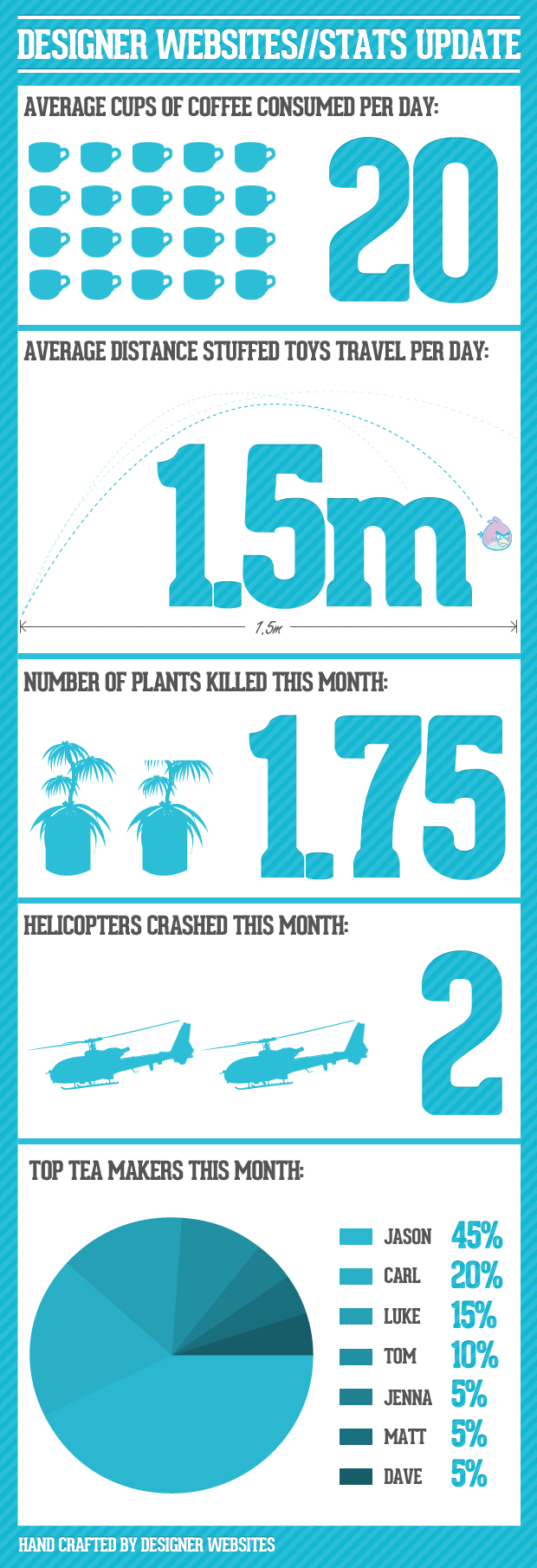
Here at DW we dont just design and develop amazing websites all day, we like to take regular breaks to keep our creativity flowing. We've created some infographics to illustrate just how we "wisely" spend our spare time!
Many companies believe that a choice must be made between usability and website SEO, with many people believing that one element has to be sacrificed for the sake of the other. Needless to say the goals of website SEO and usability are polarised, but that doesn’t mean they have to be mutually exclusive. With keen eye for functionality an experienced website developer will bring to the table, it is simple to produce a website that satisfies customers and search engines alike.
In days gone by pages produced for the purpose of website SEO were filled with text that contained a high density of keywords which often made the copy a little disjointed. Website SEO has changed drastically over the years, and now, with the assistance of a professional SEO copywriter it is possible to merge keywords with punchy text that attracts rather than deters your customer base.
So what elements should you consider when balancing usability with website SEO?
- Title tags and headings – this is one of the most important factors to get right to strike the perfect balance between SEO and usability. The title tag plays an integral part in website SEO, but it is also the first thing a user is going to see, so it has to be readable and explain accurately what the page will do. A good title tag should focus on only one to two keywords, and still make sense to readers. Every page of your website should have a different title tag.
- Usability testing – this plays an integral part in determining the user experience and how simple it is to navigate your site. Any findings which illustrate the poor usability of your site should be addressed immediately, even above website SEO considerations. If the usability of your site falls below the mark, the amount of traffic SEO helps you to attract will be for irrelevant, as poor usability will quickly lead visitors to look elsewhere.
- Keyword use – keywords should be used in the right places in the meta data as well as throughout the body copy of your page. However, don’t be tempted to indulge in keyword spamming as this not only effects usability, it is also likely to be detrimentally to website SEO as the search engines will regard the page as ‘spam’, which will hinder your rankings for the targeted keywords. Anything around 3% is the sort of keyword density you should be looking to achieve.
This is only a brief insight into the intricate balancing act between website SEO and usability, with many other factors also playing a part. For further information about usability and website SEO, please call the experienced website developers here at Designer Websites on 0845 272 6813.
When asking the question, ‘how large a part does domain age play in website SEO?’ the answer you will receive, irrespective of who you ask, will be ambiguous at best. Even Matt Cutts, the most outspoken member of Google’s Search Quality team, remains unusually vague when put on the spot. When asked that very question just recently, Matt replied: “My short answer is not to worry about that very much, not very much at all in fact.”
Most people know that when it comes to performing website SEO, domain age does have an effect, and as far as we are concerned there are two distinct reasons why:
- Older domain names are usually associated with better known, more established sites. On the whole, sites with older domain names are regarded as more relevant and trusted resources, thus boosting the website SEO.
- Spammers are not usually interested in developing the website SEO of a site for a period of over three or four years as traditionally they quickly move onto different projects. For this reason, new domain names are more associated with spam.
It’s safe to say that most website SEO specialists will agree that domain age does have some bearing on search engine rankings; it is just the extent that they find impossible to agree on.
To overplay the affect of domain age on your website SEO strategy is, in the opinion of our SEO team here at Designer Websites, probably a mistake. It is important to acknowledge it as a factor, but not to consider it to be in anyway critical to your website SEO strategy, and below, in our view, are the reasons why:
- Domains can sometimes lie dormant for years
- Established and well known companies are acquiring new domain names all the time, often using a 301 redirect from a more established domain
- Just because a domain is old it does not mean it has been subject to whitehat website SEO techniques.
Some companies will only look at buying old domains due to the importance they place on domain age. However, this is far from a fool-proof approach, as you cannot always cater for the website SEO strategy of previous owners. There may well be some goblins in the system that pose real problems for the success of your website SEO campaign.
To conclude, we all know how hard it can be during the first six months of any website SEO campaign when working on a new domain, however, stick with it and build your link profile naturally and the results will come. Have a little faith and don’t panic!
With a question that has no definitive answer, experience counts for a lot. This is one reason why the website SEO team here at Designer Websites are the first port of call for so many companies looking to further their online presence.
Hopefully we’ve all seen social sharing buttons before; to be frank you’d have done well to miss them. But just why are they becoming so prevalent and how do they contribute to your website SEO?
Some of the most popular social share buttons are those for Twitter, Facebook, Google+, email and ShareThis. These social buttons can play an important part in the promotion of content you add to your site. The addition of social share buttons essentially allows the visitors to your site to do a lot of the website SEO work for you. However, although there seems to be no downside to such a strategy, recent research shows that about half of the largest 10,000 sites do not display any kind of social sharing link or buttons at all. However, doesn’t this oversight mean such websites are missing out on valuable website SEO opportunities, given that:
• Social signals are becoming increasingly important in search engine algorithms
Over the past few years the search engines have openly admitted that social signals are becoming increasingly influential factors in rankings. This means that the more time an article or blog is shared using a social button, the greater the impact on your website SEO. By neglecting to include social share buttons on your site, your website SEO will not receive an extra push which might make all the difference.
• You’re not reaching as wide an audience as you might
The internet is an extremely crowded resource, so anything you can add to your website which increases the size of your slice of the pie should be seriously considered. Social share buttons are an excellent method of increasing your exposure in circles outside of your existing network of visitors. This helps to attract fresh traffic to your website creating new opportunities.
• User friendly content is more likely to be read
One of the main benefits of social share buttons is the fact that users do not have to leave your site to post your content. With the short attention spans of today’s internet user, keeping them on your site is tricky enough anyway without giving them a good reason to leave; by making your website as user friendly as possible, visitors will stay with you for longer, increasing the chances of a conversion.
If you’re interested in making the most of your website SEO, the team here at Designer Websites have the experience and know-how to help your website climb towards the top of the search engine rankings. For further information call our dedicated website SEO team on 0845 272 6813.